
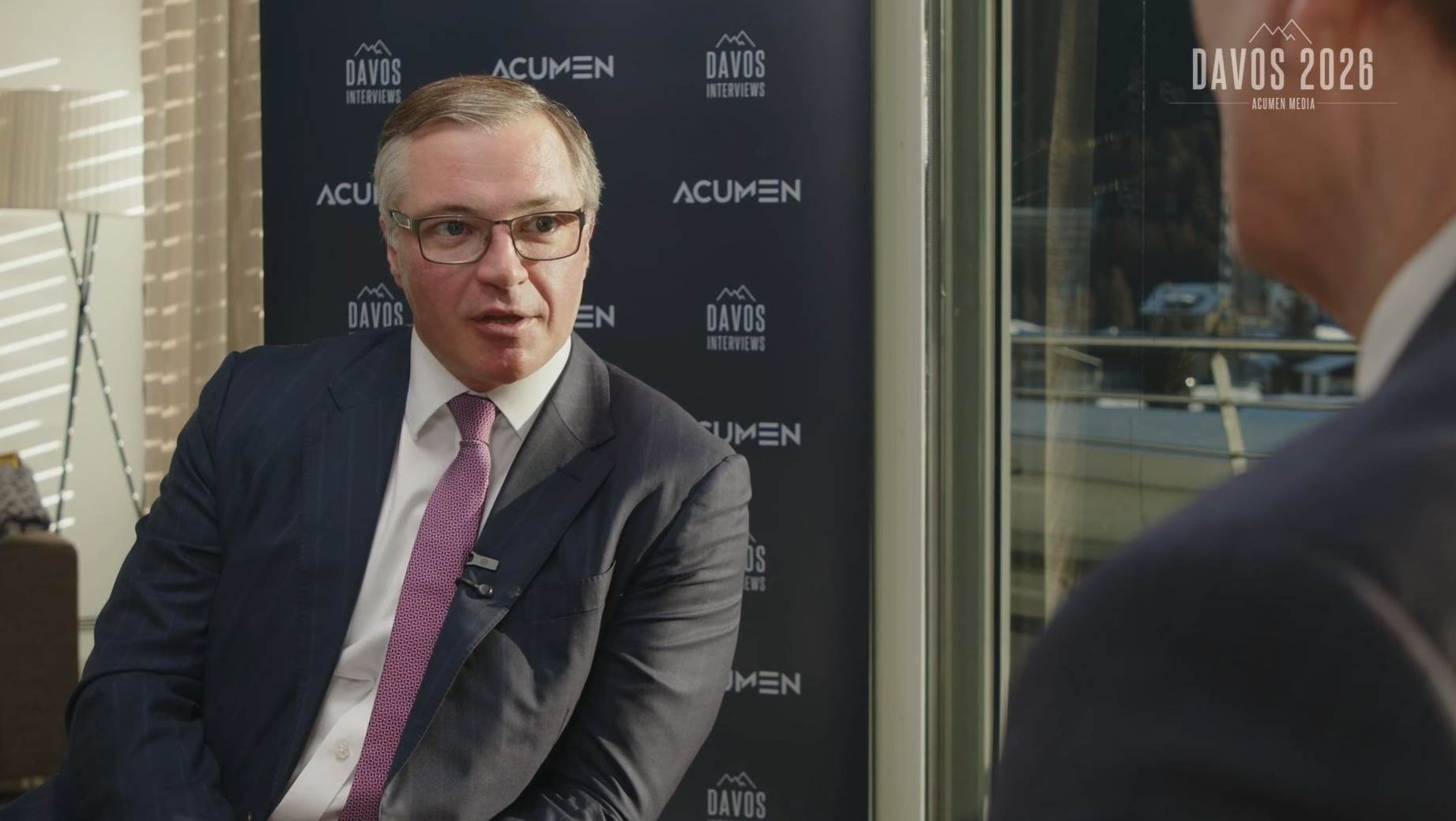
— The metals and mining sector is huge. Where does Metinvest sit within it?
Metinvest is an international metals and mining company with Ukrainian roots. Our main operations are in Ukraine, so we do iron ore mining and steel production there. And then we supply the products mainly to the European Union and the UK, and we have our processing subsidiaries in Italy, Bulgaria, Romania, and the UK.
— So, does that make Metinvest a conglomerate, a mining giant? What is your scale on the global stage?
We are rather a vertically integrated company: we cover the entire value chain — from iron ore mining to the production of finished products used, for example, in bridges, buildings and other products, including consumer goods. The idea is to serve as a bridge between Ukrainian and European markets.
— As you mentioned, you've got a lot of operations all over Europe. How are you getting on with the push towards environmental impact and efficiency?
That is the push across the entire steel industry. It is not only in the European Union; it is in Ukraine as well. So every mining and steel company is thinking about decarbonisation and efficiency.
Our efficiency starts at the iron ore mining stage and continues all the way through to the delivery of the final product to customers. We have also launched a new project — the construction of a new steel mill, Metinvest Adria, in Piombino, in the province of Livorno, Italy.
This will be one of the most modern steel mills in Europe as of now, and at the same time a pilot project. We plan to use it as a blueprint for reconstructing our facilities back home in Ukraine. For obvious reasons, during the war we cannot do major reconstruction or make major investments in Ukraine. So this plant will be used as a blueprint for renovating our facilities in Ukraine.
— The war in your country represents a whole different dimension of transformation. In recent years, you have lost some blast furnaces. How is Metinvest adapting to all of this geopolitics?
—Well, in fact, we are probably the most damaged among large industrial businesses in Ukraine, as we have lost almost half of the company. Our two large steel mills — the largest ones in Mariupol — were completely destroyed at the beginning of the invasion in 2022. We had to rearrange our logistics and adjust our raw materials supply chain. We also had to take care of our personnel, as people are effectively in danger on a daily basis due to shelling across Ukraine. At the same time, we continue to operate.
From the beginning of the invasion, the decision of our shareholder, Rinat Akhmetov, was to support the Armed Forces of Ukraine and the country as a whole. In fact, he is now spending most of his time in Kyiv, alongside the country and his fellow citizens. He established the Steel Front initiative, which brings together all of his businesses to support the Defence Forces of Ukraine.
— And at the same time, you still have a company to manage. You still have a team of staff to keep motivated and to make sure they feel safe.
Yes, that’s correct. In terms of motivation, we talk about each person’s role in this defence initiative. At the same time, it is important to look ahead and continue developing. That is why we established the first private polytechnic university in Ukraine, Metinvest Polytechnic, which started in 2022. We offer 19 bachelor’s programmes, 21 master’s programmes and five doctoral programmes. And that makes sure that when the war is over, we have fully qualified personnel for the reconstruction of Ukraine.
— Are you concerned about a skills shortage?
You should always be concerned. It's a never-ending process, especially in the steel industry when you have to innovate and prove your quality every day — if not every minute.
— You have the impact of losing production capacity and operations, while at the same time the business has to support the country during the war. How is this affecting people at Metinvest?
We are, in fact, probably the largest donor to the Armed Forces of Ukraine. Over the past four years, Metinvest has donated more than US$200 million to support the Ukrainian people and the Ukrainian armed forces, with half of this amount directed to the Defence Forces of Ukraine. In addition, we produce many items at our facilities for the army and for the protection of service personnel. For example, steel underground hospitals that can withstand a direct missile strike. We also produce defensive screens for equipment, armour plates for body armour, and a number of other products. On the one hand, this is significant support for the Ukrainian armed forces. On the other hand, it is also a very powerful motivational factor for our people, because they understand that even though they are not fighting on the frontline, they are part of the defence effort and an integral part of the country’s defensive system.
— Steel is often seen as part of a “dirty” energy conglomerate, alongside oil, gas and mining in general. But steel is different in a way. Yes, it is a “dirty” industry that is cleaning up, but at the same time it is not a transitional material by any means, is it?
Not exactly. In my view, steel will remain with us for a long time to come. It is present in every infrastructure project and in most consumer goods. I believe it is not going anywhere. At the same time, it is important to remember that steel is the most recyclable material. It can be recycled 100% and used again and again. Most of the steel products we use today were originally made from steel produced more than 100 years ago. In this sense, steel can become an ideal material once we move to low-carbon steel production. At that point, it can truly become the most sustainable material.
— So steel is improving and market expectations are rising. How are you adapting to that?
We have to adapt not only because we operate in the steel industry, but also because we are operating in a highly volatile wartime environment in Ukraine. That is why we are extremely flexible in terms of supply chains and our operations. Our people show remarkable resilience when it comes to responding to external threats. This is one of the few positive lessons of the war — we had to learn all of this, otherwise we would not have survived.
— And in terms of product quality, is that also changing and improving?
You have to work on product quality all the time. In the steel industry, you cannot simply stop and say, “This is the product I will sell forever.” No — the industry moves on, every player finds better ways of producing and improves quality for customers. So we have to keep improving.
— Yuriy, earlier you mentioned that you see your career in the mining and steel sector. How confident are you now about the future of this industry?
I believe the future is there. If you look at iron ore reserves worldwide, and in Ukraine in particular, they are sufficient for more than 100 years, even based only on proven deposits. As I mentioned earlier, steel is one of the most universal materials in the world, if not the most universal. Therefore, I think the future applications of steel will be enormous. And the fact that the steel industry is now strongly driven towards producing low-carbon or even carbon-neutral steel gives this product the opportunity to become the material of the future.